
Roof Systems
60-Mil TPO Roof Systems in Winston-Salem, NC
60-Mil TPO on Winston-Salem Manufacturing and Distribution Roofs
Sixty-mil TPO is the membrane thickness most commercial owners in the Winston-Salem area default to when a low-slope roof needs a durable, weldable single-ply system without paying for wind and hail performance the building does not require. We treat the thickness call as a specification decision tied to deck type, rooftop traffic, and wind exposure, not a line item to negotiate down after the fact.
Where 60-mil fits in a Triad roof file
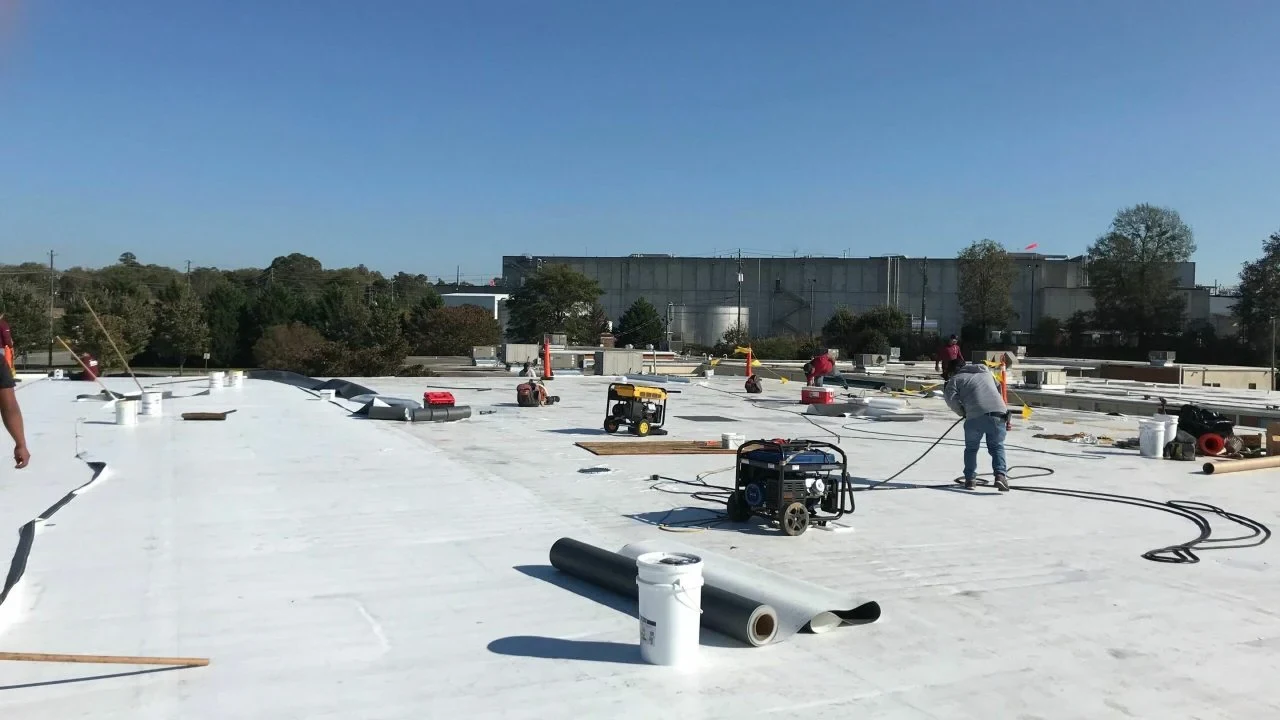
A steel deck warehouse along the I-40 corridor near Kernersville, a single-story office building off Peters Creek Parkway, or a low-traffic retail box in Clemmons are typical candidates for 60-mil TPO. The membrane carries enough reinforced strength to resist normal foot traffic from mechanical service and enough seam integrity for a fully adhered or mechanically attached assembly, without the added material cost of 80-mil sheet in applications that will not see repeated rooftop equipment changeouts.
We do not specify 60-mil as a default answer for every roof. Buildings with rooftop units serviced several times a year, buildings near I-85 industrial parks with regular crane or lift access, or buildings carrying legacy patch work from a prior membrane usually move the conversation toward 80-mil. The thickness decision belongs in the submittal package alongside deck attachment, insulation R-value, and drainage detail, not decided by price alone.
Hot-air welding inside a Piedmont humidity window
TPO seams are only as good as the weld, and weld quality is sensitive to surface moisture and dew point. Winston-Salem summers run humid enough that morning dew and afternoon storm buildup can leave a membrane surface damp well past sunrise, which changes when a crew can safely start heat-welding seams. We build weld inspection into the schedule rather than assuming a printed start time will match field conditions on a given July morning.
Seam probing after welding is a basic quality step we do not skip, particularly on a re-cover over an older built-up roof where deck irregularities can create cold spots in the weld pattern. A probed seam that fails gets rewelded before the crew moves to the next section, not noted for a punch list at the end of the job.
Wind uplift and fastening for thunderstorm season
The Piedmont Triad sees regular severe thunderstorm activity from spring through late summer, with straight-line wind gusts that stress perimeter and corner fastening more than the field of the roof. Sixty-mil TPO can carry adequate wind uplift ratings for most low-rise commercial buildings when the fastening pattern, plate spacing, and perimeter enhancement are engineered to the building's actual exposure category, not a generic pattern copied from a different job.
Edge metal and coping performance matter as much as the field membrane during a downburst event. We check parapet height, cleat engagement, and termination bar spacing on every 60-mil specification because a wind event that peels edge metal will take membrane with it regardless of how well the field seams were welded.
- Deck type and attachment method confirmed before membrane thickness is finalized.
- Rooftop traffic frequency reviewed against mechanical service records where available.
- Wind uplift rating matched to the building's exposure category and parapet height.
- Weld schedule set around dew point and forecast humidity, not a fixed start time.
- Seam probe results logged section by section during installation.
- Edge metal and coping fastening verified separately from field membrane inspection.
Re-cover economics on tobacco-era industrial stock
Tobaccoville and the manufacturing corridor around it carry a concentration of large-footprint industrial buildings built during an earlier era of tobacco and textile production. Many of these roofs are original built-up or aged EPDM assemblies where a full tear-off is not always the first responsible option. A 60-mil TPO re-cover over a dry, structurally sound substrate can extend service life at a fraction of tear-off replacement cost, provided a moisture survey confirms the existing insulation will not trap water under the new membrane.
We do not recommend a re-cover without that moisture verification step. Infrared scan or core cuts tell us whether the old assembly is dry enough to build over, and that finding goes into the file before a re-cover price is presented. Skipping the survey to save a day of scheduling time is how a re-cover turns into a warranty dispute two winters later.
Warranty and submittal documentation
A 60-mil TPO warranty is only as reliable as the paperwork behind it. We document deck condition, insulation type and thickness, fastening pattern, and seam welding records as part of the closeout package, because manufacturer warranty terms typically require that installation records match the approved system components. Owners comparing bids should ask for this documentation regardless of which contractor they choose.
Procurement teams managing multiple buildings across the Triad often want a consistent 60-mil specification they can reuse across similar low-traffic roofs. We can build that standard specification once and apply it building by building, adjusting only the wind uplift and attachment variables that change with each site's exposure and parapet condition.
Questions owners raise about 60-mil TPO
Is 60-mil TPO strong enough for a warehouse roof?
For most single-story distribution and light manufacturing buildings with limited rooftop traffic, 60-mil TPO carries adequate puncture and tensile performance. Buildings with frequent mechanical service or crane access are the cases where we push the conversation toward 80-mil.
Can 60-mil TPO go over an existing built-up roof?
Sometimes, if a moisture survey confirms the existing insulation is dry and the deck is structurally sound. We do not recommend a re-cover without that verification step regardless of how the roof looks from the ground.
How does humidity affect the installation schedule?
Hot-air welding requires a dry membrane surface, and Piedmont summer humidity can delay a morning start well past sunrise. We build the weld schedule around forecast dew point rather than a fixed crew start time.
What wind rating does 60-mil TPO need for this area?
The required uplift rating depends on building height, parapet condition, and exposure category, not a single number that applies everywhere. We calculate the fastening pattern for each roof rather than reusing a generic spec.
Does 60-mil TPO carry the same warranty length as 80-mil?
Warranty terms depend on the manufacturer's published program and the specific system components installed, not the membrane thickness alone. We document the exact system specified so the warranty terms can be confirmed against manufacturer literature before the project is priced.