
Roof Systems
Spray Polyurethane Foam Roofing in Winston-Salem, NC
Spray Polyurethane Foam for Complex Rooflines Downtown and Across the Triad
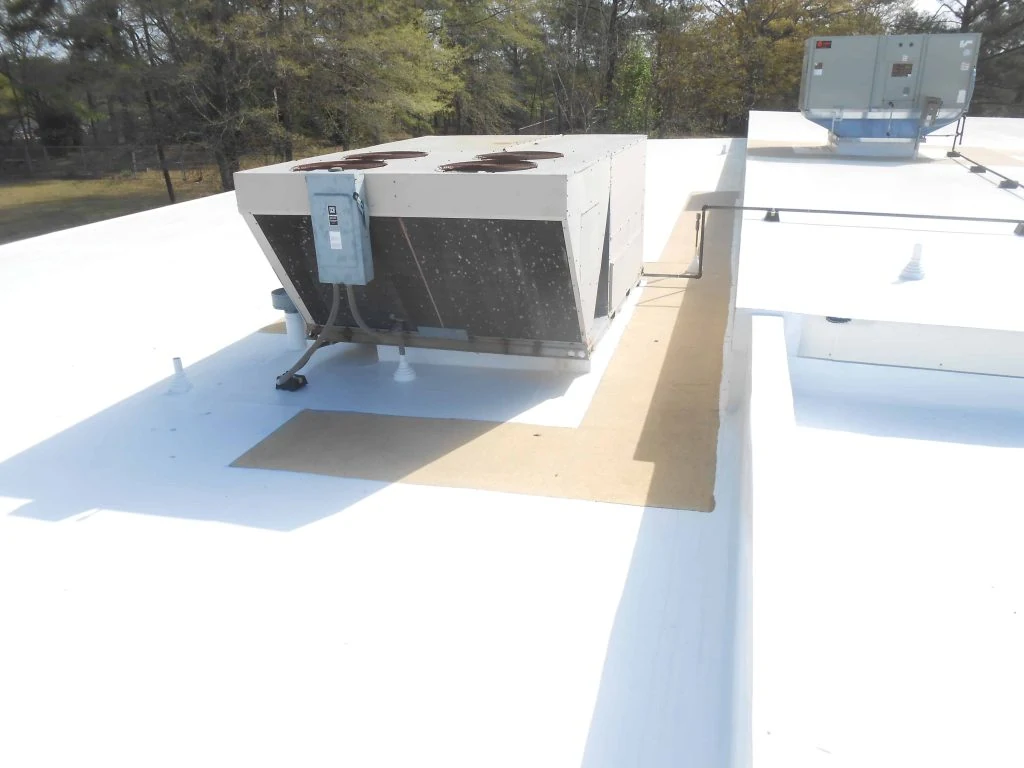
Spray polyurethane foam solves roofing problems that membrane systems handle poorly: irregular rooflines, additions with mismatched deck heights, and roofs where insulation and waterproofing need to happen in a single continuous application. We specify SPF selectively, where the roofline complexity or renovation history of a building makes it the more practical system, not as a general substitute for membrane roofing.
Where roofline complexity favors foam over membrane
Buildings downtown within and around the Innovation Quarter, many converted from earlier industrial and warehouse use into research, office, and hospitality space, often carry rooflines altered by decades of additions, mechanical penthouse construction, and structural changes that left multiple deck heights and transition details in a small footprint. Membrane roofing on these roofs means numerous flashing details and seams concentrated in a small area. Spray foam applies as a monolithic, unbroken surface that follows the existing roofline contour without requiring the same density of flashing transitions.
We evaluate roofline complexity directly during the roof walk rather than defaulting to foam wherever an owner requests it, since a simple rectangular roof with standard parapet height is usually better served by a standard membrane system with established long-term performance history.
Application conditions and the Piedmont humidity window
SPF application is more sensitive to humidity and dew point than membrane welding, and spraying foam in conditions above the manufacturer's specified dew point threshold can cause surface defects that affect both insulation performance and the protective coating applied over the foam. Piedmont summer mornings frequently start with humidity above acceptable spray thresholds, which narrows the practical application window on many projects to specific hours rather than a full working day.
We schedule SPF application around measured field conditions, including surface moisture readings and forecast dew point, rather than a fixed daily start time. A crew ready to spray at seven in the morning during a humid Piedmont summer stretch may need to wait several hours for conditions to clear, and that schedule reality should be built into the project timeline from the start rather than discovered mid-project.
Protective coating and recoat maintenance cycles
SPF roofing requires a protective coating over the foam, typically acrylic or silicone, since the foam itself is not UV stable and degrades under direct sun exposure without that protective layer. The coating and its recoat interval are as much a part of the specification as the foam thickness, and we document the manufacturer's recommended recoat cycle in the closeout file so future facilities staff know the maintenance obligation attached to an SPF roof.
Owners considering SPF for the first time sometimes underestimate this ongoing maintenance requirement compared to a standard membrane roof's inspection cycle. We present that maintenance obligation clearly during the proposal stage, since an SPF roof neglected past its recoat interval degrades faster than a membrane roof left on a similar inspection schedule.
- Roofline complexity assessed directly during the roof walk before recommending foam over membrane.
- Field dew point and surface moisture measured before any spray application begins.
- Foam thickness specified separately from the protective coating thickness and type.
- Recoat interval documented in the closeout file with manufacturer maintenance requirements.
- Wind and impact resistance reviewed against the specific coating and granule system selected.
- Existing deck and structural transitions mapped before foam application to confirm substrate compatibility.
Wind, hail, and ice storm resilience of coated foam
A properly coated SPF roof performs reasonably against wind uplift because the foam is fully adhered to the deck rather than mechanically fastened at discrete points, removing the fastener-pattern vulnerability that affects some membrane systems during Piedmont thunderstorm season. Hail and impact resistance depend heavily on the specific coating and any embedded granule system, and we review manufacturer impact resistance ratings for the specific product combination rather than assuming all coated foam performs identically.
Winter ice storm cycling affects coated foam differently than membrane, since foam does not have field seams to work loose under freeze-thaw stress, though coating integrity at parapet and penetration transitions still needs the same inspection attention any roof system requires ahead of winter weather.
Reroof economics on renovated downtown buildings
Downtown buildings that have gone through adaptive reuse from industrial or warehouse space into research, office, or hospitality use frequently carry roof geometry that a full membrane replacement would need to work around expensively, given multiple deck heights and mechanical penthouse additions from various renovation phases. SPF's ability to follow existing contours without excessive flashing transitions can reduce both material waste and installation time compared to forcing a membrane system to conform to an irregular substrate.
We present that comparison honestly when a building qualifies for either approach, since foam is not automatically the lower-cost option once ongoing recoat maintenance is factored across the roof's service life.
Questions building owners ask about spray foam roofing
Is spray foam a good fit for any commercial roof?
It works best on roofs with complex geometry, multiple deck heights, or renovation history. A simple rectangular roof is usually better served by a standard membrane system.
Why does SPF application get delayed on humid summer mornings?
Foam application requires dew point and surface moisture within manufacturer thresholds, and Piedmont summer humidity often keeps conditions above that threshold well into the morning.
Does spray foam need ongoing maintenance beyond a membrane roof?
Yes. The protective coating over the foam has a recoat interval that must be maintained, since the foam itself is not UV stable without that coating layer.
How does SPF perform in thunderstorm wind conditions?
Fully adhered foam removes the fastener-pattern vulnerability some mechanically attached membranes face, though the actual wind performance depends on the specific coating system applied over it.
Is spray foam roofing less expensive than membrane replacement?
Not automatically. Installation cost may be lower on complex rooflines, but ongoing recoat maintenance needs to be factored across the roof's service life before comparing total cost.